Fire Alarms

Systems for Domestic Houses

Fire detection systems are at the core of fire alarm systems, whether at home or in a business, these systems can be directly responsible for life and death.

Every new house built must have fire detection installed, at least in;

  • All circulation areas that form part of an escape route within the building
  • All High risk areas/rooms eg. Kitchen, Living Room
  • All Bedrooms

For older homes, you can put up stand alone detectors, or connect wireless smoke detectors to your house alarm.

Integrating smoke detectors with your security alarm system means you have the extra benefit that your fire alarm will be monitored alongside your intruder alarm, so if a smoke detector goes off, you will be contacted by the monitoring station.

Systems for Small, Medium and Large Commercial Premises

Systems for Small, Medium and Large Commercial Premises

For new commercial premises, fire detection systems have to be installed to ensure fire certification is approved and the building will be allowed to be occupied. Hall Alarms install all Fire Alarms Systems to I.S. 3218: 2024. This is the standard that controls the design, installation and servicing of systems. It is the law that Fire Alarms Systems must be serviced by a competent company every quarter, ie every 3 months.

Despite businesses having insurance policies, nearly 80% of businesses that are seriously damaged due to fire never recover. This is because while a claim and rebuild is being administered, you have nowhere to sell your product, no money coming into the business and suppliers and staff looking for their money.

Which system suits you better?

Conventional Type

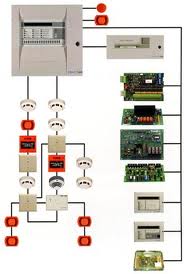
Conventional Fire Alarms are the simplest of fire detection systems. They will detect fire and alert people in the building with an audible and visual alarm. They cannot individually identify which detector activated the control unit, you will be told which zone has activated the system.

Download BROCHURE

Addressable Type

Addressable Type

This type of system gives each detector on a system an individual number, or address. Thus, the control panel, and therefore fire fighters, know the exact location of an alarm where the address is indicated on a diagram.

Intelligent addressable detectors provide information about the amount of smoke in their detection area, so that the system can decide itself, if there is an alarm condition in that area (possibly considering day/night time and the readings of surrounding area detectors).

Download BROCHURE

Detection Devices

Smoke Detectors

Smoke Detectors

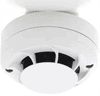
In the most common type of optical unit, light is scattered by smoke particles onto a photocell, initiating an alarm.

Download BROCHURE

Heat Detectors

These are “Not a life safety device”. That is because heat detectors are not meant to replace smoke detectors in the bedrooms or in the hallway outside of the bedrooms.
A heat detector will nonetheless notify of a fire in a kitchen or utility area (i.e. boiler house, laundry room, garage), where smoke detectors might not be suitable. This will allow extra time to evacuate the building or to put out the fire if possible.

Heat Detectors

Rate-of-Rise (ROR) heat detectors operate on a rapid rise in element temperature of 67° to 83°C increase per minute, irrespective of the starting temperature.

This type of heat detector can operate at a lower temperature fire condition than would be possible if the threshold were fixed.

Download BROCHURE

Manual Call Points MCP (Formerly called Break Glass Units)

Manual Call Points MCP (Formerly called Break Glass Units)

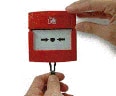
Used by building occupants to notify others of the presence of a fire, if it is noticed before the detectors set off the alarm.

Download BROCHURE

Aspirating Smoke Detector (ASD) (Early Warning Fire Detection)

Vesda Aspiration
Vesda Aspiration

Aspiration Systems can detect fires at a very early stage, often before visible smouldering takes place, before an open fire occurs and before intense smoke develops. This early detection is vital to mission critical and high risk applications. The earliest possible fire detection brings significant time benefits, enabling a fast response to the first signs of smoke. ASD can detect fires with more sensitivity, if required, than point smoke detectors.

Operation:

ASD systems draw air samples continuously from the monitored area through a pipe system fitted with sampling holes at regular intervals. The airflow is then analysed for smoke particles and an alarm is raised if smoke is present.

Download BROCHURE

Fire Ray Beam

Fire Ray Beam

Optical Beam Smoke Detectors are used to provide “wide area” smoke detection. These are usually used in situations where it is impractical, inappropriate or not cost effective (installation, wiring and maintenance) to use traditional point-type detectors. It also enables coverage of a large area, at minimal cost.

Download BROCHURE
Request a Quote